

Warehouse and fulfillment leaders are operating in a new reality. Labor shortages persist, wages continue to rise, order profiles grow more complex, and customer expectations move in only one direction: faster and more accurate.
This guide explains how to evaluate the return on investment (ROI) of autonomous mobile robots (AMRs) in warehouse automation so decision-makers can determine whether automation delivers measurable financial value.
Automation has become a strategic lever, but adopting new technology simply because it is innovative is not a business strategy. The real question is: What measurable return will this investment generate?
Autonomous mobile robots (AMRs) are one of the most flexible and scalable forms of warehouse automation. When deployed within a broader system strategy, they can reduce operating costs, increase throughput, and improve safety. This article outlines AMR deployment costs, total cost of ownership (TCO), labor productivity gains, throughput improvements, and payback considerations to help leaders build a defensible business case.
In this guide:
What Are AMRs?
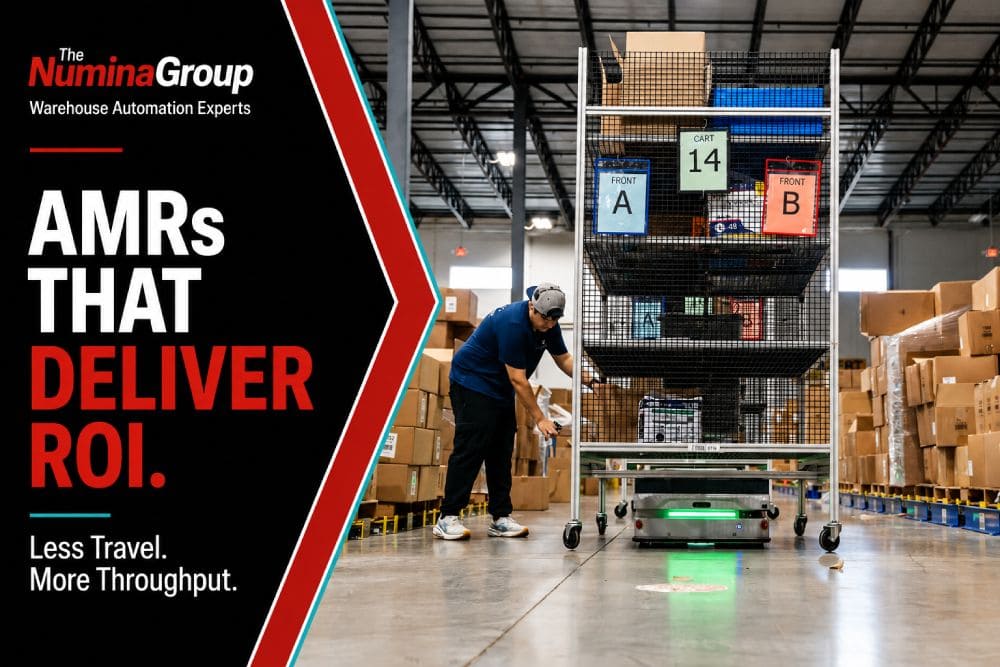
Autonomous mobile robots are software-driven robotic systems that navigate warehouse environments without fixed infrastructure such as embedded wires, magnetic tape, or fixed rails. Using a combination of sensors, cameras, LiDAR, and onboard computing, AMRs build maps of their surroundings and move dynamically around people, equipment, and inventory.
Unlike traditional automated guided vehicles (AGVs), which typically follow predefined routes, AMRs make real-time decisions. They can reroute around congestion, adjust to layout changes, and operate in mixed human environments without extensive facility modification.
In warehouse and fulfillment settings, AMRs are commonly used for:
- Transporting picked items from zones to packing stations
- Supporting goods-to-person picking workflows
- Moving inventory for replenishment
- Consolidating orders for sorting and shipping
- Assisting with returns processing
Rather than replacing every aspect of warehouse labor, AMRs typically remove the most time-consuming and physically demanding tasks, particularly travel. That shift is where much of the financial return originates.
The Operational Challenges AMRs were Built to Solve
To understand the ROI of AMRs, it helps to examine the inefficiencies common in manual warehouses.
In many facilities, associates spend a large percentage of their shift walking. Travel time between pick locations, zones, staging areas, and packing stations often consumes more labor hours than actual picking. That walking does not add value. It simply moves product from one point to another, and it wears people down. Facilities paying the price for that fatigue see it in turnover numbers, error rates under peak pressure, and safety incidents tied to congestion and repetitive strain
At the same time, facilities face high turnover and training costs, seasonal labor spikes, increased error rates under peak pressure, and safety risks tied to congestion and repetitive strain. AMRs directly target these pain points. By automating transport and synchronizing movement across the warehouse, they reduce non-value-added activity and allow human workers to focus on tasks that require judgment and dexterity.
Warehouse Automation with AMRs: Key Operational Benefits
AMRs deliver value in more than one dimension. Their impact is operational, financial, and strategic. From reducing wasted motion on the warehouse floor to increasing order velocity and improving workplace conditions, these systems influence the metrics that matter most to leadership. Understanding the full range of their benefits is critical when building a business case grounded in measurable performance improvement.
1. Labor Reallocation & Productivity Gains
One of the most immediate benefits of AMRs is the reduction of travel time. When robots handle product transport, pickers remain in optimized zones. Instead of walking miles per shift, they focus on selecting items.
This shift produces measurable outcomes:
- More picks per labor hour
- Fewer total labor hours per order
- Lower overtime expenses
- Reduced reliance on temporary labor during peak seasons
Rather than eliminating jobs outright, many operations reassign workers to higher-value roles such as quality control, exception handling, or process improvement.
2. Improved Worker Safety & Ergonomics
Long walking distances, manually pushing heavy loads, and congestion between pedestrians and forklifts increase injury risk. AMRs reduce foot traffic across long travel paths and limit unnecessary interactions between people and heavy equipment.
Fewer injuries translate to lower workers’ compensation claims, fewer lost-time incidents, and improved workforce morale.
3. Increased Throughput & Faster Cycle Times
Because AMRs can operate continuously and in parallel with human tasks, they help eliminate bottlenecks between zones. Robots move while workers pick. Orders flow more smoothly to packing and shipping. The result is higher order throughput per hour and shorter order cycle times. Facilities can handle greater demand without expanding headcount proportionally.
4. Higher Accuracy & Reduced Errors
AMR systems are typically integrated with warehouse management systems (WMS) or warehouse execution systems (WES). This integration supports guided workflows, structured routing, and synchronized order handling. That improved process control often leads to fewer mispicks, lower return rates, and reduced rework and reshipping costs.
5. Scalability & Flexibility
Unlike fixed conveyor infrastructure, AMR fleets can scale incrementally. Additional robots can be introduced to meet seasonal peaks, promotional surges, or long-term growth without major construction or operational disruption.
This modular approach gives leadership greater financial control. Capacity can expand in phases, aligned with demand and budget cycles, rather than requiring a large, single capital commitment upfront, and layouts can be modified without ripping out major hardware. Workflows can be redesigned as SKU profiles change, new product lines are introduced, or order volumes shift across channels. As distribution strategies evolve, the robotic fleet can adapt alongside them.
This flexibility helps future-proof the automation investment and reduces the risk of being locked into rigid infrastructure that may not support tomorrow’s operational model.
AMR Deployment Costs
A clear ROI model requires a complete view of investment costs. These extend beyond the robot purchase price and should be evaluated across the full lifecycle of the solution.
Too often, organizations focus narrowly on the unit price of a robot and overlook integration, infrastructure, software, and long-term support. A comprehensive cost analysis provides leadership with a realistic financial picture and prevents surprises after deployment.
Capital Expenditure vs Robotics-as-a-Service (RaaS)
Organizations may acquire AMRs through a traditional capital purchase or an RaaS model, where robots are provided under a subscription structure. A capital model involves higher upfront cost but full asset ownership, over a longer deployment horizon, a lower total cost of ownership. An RaaS model reduces initial expenditure and shifts costs into operating budgets, which may align better with cash flow strategies.
The selection between these models often depends on financial strategy, tax considerations, and growth projections. Some companies prefer ownership and depreciation advantages, while others favor predictable monthly operating expenses and lower upfront commitment.
Hardware & Equipment
Core hardware costs include the physical components required to deploy and sustain the robotic fleet, such as robot units, charging stations, batteries, and operational attachments like carts, shelves, or tote carriers. Hardware and equipment costs are also impacted by fleet size, which depends on throughput targets, facility layout, and order profiles.
These elements form the backbone of the system and directly influence performance capacity and reliability.
Why Most AMR Integrations Fall Short (And How RDS Fixes It)
- Most AMR deployments underperform not because the robots fail, but because the software layer connecting them to the rest of the warehouse never reaches its potential. Fleet management software alone is not enough. Without deep integration into order management, inventory logic, and workflow execution, robots follow instructions without understanding context.
- This is where RDS, Numina’s proprietary Warehouse Execution System, makes the difference. RDS acts as the operational brain of the warehouse, coordinating AMR activity alongside every other system and resource in real time. Rather than treating robots as standalone assets, RDS synchronizes them with WMS order data, ERP inventory logic, labor workflows, and end of line automation, so the entire facility operates as a single coordinated system.
- Most robotic integrators cannot offer this layer. They bring the hardware and leave the orchestration to others. Proper integration connects every robot to live order data, inventory logic, and workflow rules, allowing the entire warehouse to operate as a coordinated ecosystem rather than a collection of isolated technologies. Numina brings both the hardware expertise and the orchestration layer, which is why RDS-powered deployments achieve faster time-to-value and stronger long-term performance.
Infrastructure & Facility Adjustments
Most AMR systems require reliable wireless connectivity and a facility layout that supports safe, efficient navigation. Compared to conveyor systems, facility modifications are generally lighter, but they still carry cost considerations.
In many cases, the required changes are modest compared to large-scale conveyor installations. However, network upgrades, aisle adjustments, traffic flow redesign, or safety enhancements may still be necessary to support optimal performance. In some cases, facilities upgrade Wi-Fi networks or reconfigure aisle layouts to support smoother robot navigation.
Startup, Training, & Maintenance
Implementation includes system design, commissioning, user training, and ramp-up. During this phase, workflows are refined, system parameters are adjusted, and teams adapt to new processes.
Long-term performance depends not only on the hardware itself but also on disciplined maintenance practices and ongoing system support. Ongoing costs may include preventative maintenance, spare parts, software licensing or support, and energy consumption.
A total cost of ownership (TCO) model should capture all of these elements over a multi-year horizon.
AMR Financial Payoffs
While the cost side of AMR deployment requires careful planning, the return side is where the strategic value becomes visible.
The financial impact of AMRs is rarely limited to a single line item on a balance sheet. Instead, gains compound across labor efficiency, throughput capacity, error reduction, safety performance, and long-term facility planning. When these improvements are modeled together, the total economic benefit often exceeds initial expectations.
1. Reduced Personnel Costs
When travel time drops and productivity rises, labor hours per order decline. Even if headcount remains steady, the facility can process more volume with the same workforce. In some operations, AMRs allow leadership to avoid incremental hiring as demand grows. In others, they reduce overtime or temporary staffing expenses.
This shift changes the cost structure of fulfillment operations. Instead of scaling labor in direct proportion to order growth, organizations can decouple volume from headcount increases. Over time, that leverage significantly improves operating margins.
2. Increased Revenue Capacity
Higher throughput enables the business to fulfill more orders per day. That added capacity can support growth without expanding square footage or adding shifts.
In high-growth environments, this additional capacity becomes a competitive asset. The organization can accept larger contracts, support omnichannel expansion, or respond quickly to demand spikes without operational strain.
In competitive markets, faster cycle times and reliable shipping performance can also strengthen customer relationships.
3. Lower Error & Return Costs
Each picking error carries hidden expenses: customer service time, reverse logistics, reshipping, and potential lost business. Reducing error rates produces direct and indirect financial gains.
Improved accuracy also protects brand reputation. Fewer mistakes translate into higher customer satisfaction, stronger retention, and reduced friction in post-sale support operations.
4. Reduced Injury-Related Costs
Fewer injuries lower insurance premiums, claims, and lost productivity. Over time, improved safety performance can influence workforce stability, morale, and hiring competitiveness. A safer facility often experiences lower turnover and reduced disruption from unplanned absences. While harder to quantify than labor savings, these costs contribute to the overall ROI profile.
5. Deferred Capital Expansion
By extracting more productivity from existing square footage, leadership gains flexibility in long-term capital planning. Funds that might have been allocated to real estate expansion can instead support strategic initiatives such as technology upgrades, market expansion, or product development.
If AMRs help a facility increase output within its existing footprint, organizations may postpone costly expansions or new building projects. That delay alone can represent substantial financial value.
How to Calculate the ROI of AMRs
ROI analysis begins with baseline data, but it should not stop there. Calculating return requires connecting operational performance to financial outcomes in a structured, defensible way. Leaders need visibility into where time is spent, where money is consumed, and how automation shifts both variables.
A strong ROI model ties measurable warehouse metrics directly to cost reduction and revenue capacity. The following framework outlines how to approach that analysis step by step.
Step 1: Establish Current Performance Metrics
Before modeling improvement, organizations must understand their current operating profile in detail. This phase often reveals inefficiencies that were previously assumed to be unavoidable.
Key metrics to capture before implementation include the following:
- Orders processed per hour
- Average order cycle time
- Cost per pick
- Labor hours per shipment
- Error and return rates
- Safety incident rates
This data provides the reference point for measuring improvement. Without an accurate baseline, projected gains lack credibility and post-implementation performance cannot be validated objectively.
Step 2: Model Expected Improvements
Once baseline performance is documented, the next step is to model realistic operational changes driven by AMR deployment. These projections should be grounded in workflow analysis, travel-time reduction estimates, and system design assumptions – and should favor conservative estimates over optimistic ones. A credible ROI model holds up under scrutiny. An overstated one erodes stakeholder confidence before the first robot is deployed.
Projected gains may include the following:
- Percentage increase in throughput
- Reduction in labor hours per order
- Decrease in cost per pick
- Shorter cycle times
- Lower error rates
Step 3: Calculate Financial Impact
Operational improvements must then be translated into financial terms. This stage is where productivity metrics become executive-level decision data, clarifying whether the projected gains justify the required investment, and determining how quickly the organization can recover its capital outlay.
Translate operational improvements into financial terms, such as annual labor savings, additional revenue capacity, safety-related cost reductions, and savings from reduced errors and returns. Subtract total implementation and operating costs to determine net annual benefit.
Step 4: Evaluate Financial Indicators
With net annual benefit established, traditional financial metrics can be applied to evaluate the strength of the investment. Common financial measures include payback period, net present value (NPV), internal rate of return (IRR), and TCO.
For many warehouses, payback periods range from one to three years, depending on labor intensity and order volume. Cost recovery is the floor, not the ceiling. The operations that get the most from AMR investment are the ones that treat it as infrastructure for growth, not just labor offset.
FAQs About the ROI of AMR Warehouse Automation
How Long Does It Take to See ROI from AMRs in a Warehouse?
Most warehouses see a payback period between one and three years, depending on labor intensity, order volume, and operational complexity. Facilities with high travel time and labor costs often experience faster returns. A detailed ROI model based on baseline performance data provides the most accurate timeline.
Are AMRs Better Than Conveyor Systems for Warehouse Automation?
AMRs and conveyor systems solve different challenges. Conveyors are effective for fixed, high-volume flow paths, while AMRs offer flexibility, scalability, and lower infrastructure commitment. For operations with changing SKU profiles or growth plans, AMRs often provide stronger long-term adaptability.
Do AMRs Eliminate Warehouse Jobs?
In most cases, AMRs reallocate labor rather than eliminate it. Robots handle repetitive transport tasks, allowing employees to focus on picking, quality control, exception handling, and higher-value activities. This shift often improves productivity and job satisfaction.
What Factors Have the Biggest Impact on AMR ROI?
Labor cost, order volume, travel distance, and picking inefficiencies typically have the greatest influence on return. Facilities with long walking paths and high turnover tend to see significant gains. Integration quality and system design also play a major role in overall financial performance.
What Are the Ongoing Costs Associated with AMRs?
Beyond initial deployment, organizations should account for maintenance, software support, energy consumption, and potential fleet expansion. A total cost of ownership approach helps leadership understand long-term financial impact.
Can AMRs Scale as Warehouse Demand Grows?
Yes, one of the primary advantages of AMRs is modular scalability. Additional robots can be added as order volume increases without major facility reconstruction. This flexibility allows operations to align automation investment with business growth.
Ready to Build Your AMR Business Case
The data exists in your operation right now. Travel times, labor hours, error rates, cycle times – these numbers tell the story of where automation delivers return and where it doesn’t.
At The Numina Group, we engineer solutions that connect robotics, software, and warehouse systems into a coordinated operation built for performance and scalability. Our team works alongside your leadership to model expected returns, validate assumptions, and build a practical roadmap that converts automation investment into sustained competitive advantage.
The greatest returns occur when automation is aligned with operational data, integrated with existing systems, and engineered around real workflows rather than theoretical layouts. If you are considering AMR warehouse automation, the next step is a detailed operational assessment grounded in real data from your facility.
Contact Numina today to begin your warehouse automation assessment.