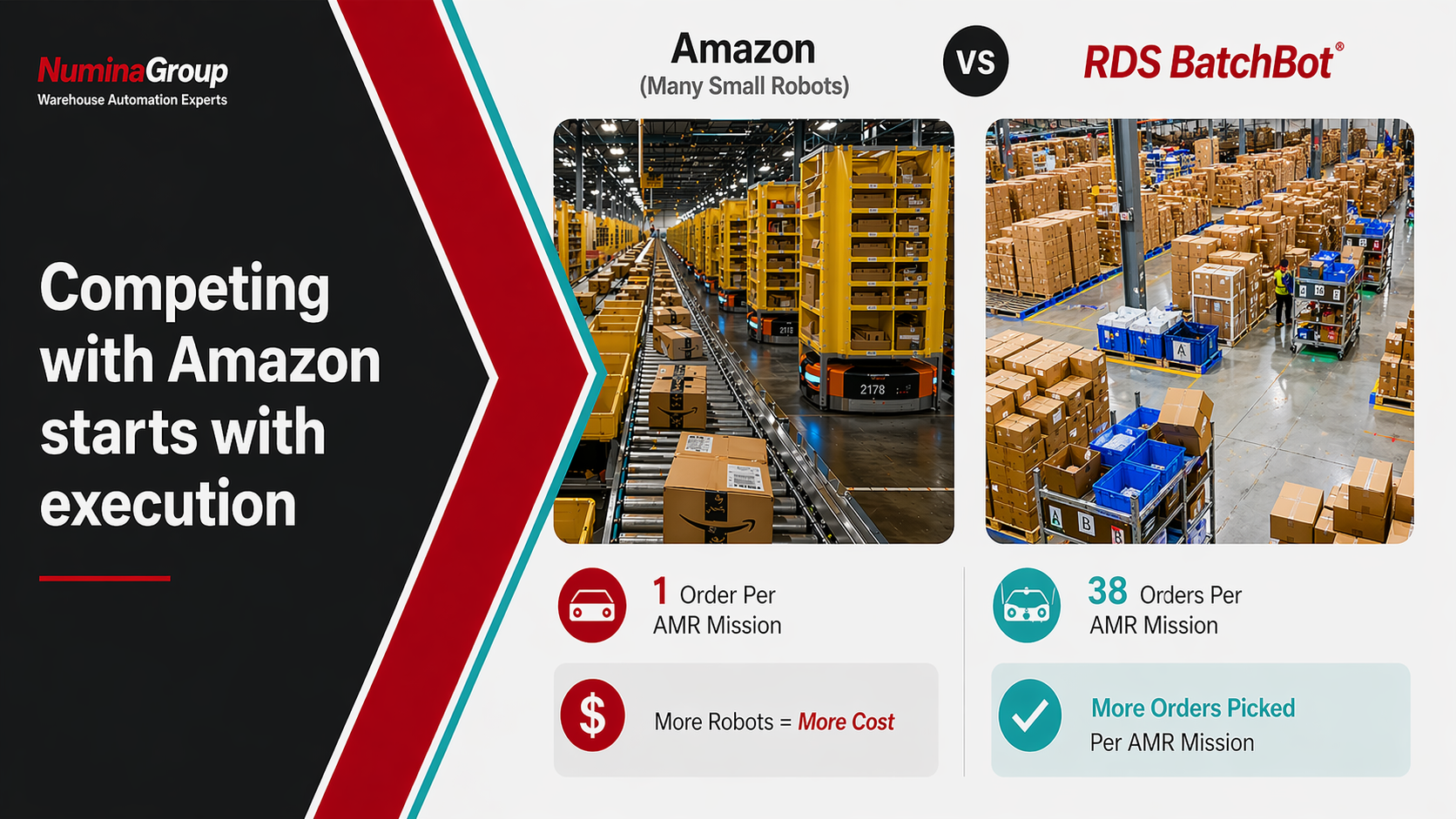



Amazon has permanently changed what customers expect from fulfillment operations. Benefits like two-day shipping and same-day delivery are common, and customers expect real-time order tracking. Inventory accuracy is taken for granted. Customers compare every experience to the speed and transparency of Amazon, regardless of company size.
But competing with Amazon doesn’t have to mean copying Amazon’s footprint, workforce, or capital investment. It just requires building a warehouse operation that is faster, more accurate, data-driven, and scalable within your own business model.
Warehouse automation is the foundation that makes this possible.
This guide was developed by the warehouse automation engineering team at The Numina Group to help distributors, manufacturers, ecommerce operators, and third-party logistics providers design warehouse automation strategies that reduce cost per order, increase throughput, and deliver Amazon-level performance without Amazon-level infrastructure. With the right technologies, system architecture, software orchestration, material handling automation, and integration strategy, mid-market and enterprise operations can dramatically reduce cost per order, increase throughput, and deliver the level of service customers now expect.
In this guide:
- What Is Warehouse Automation?
- Types of Automation Used in Fulfillment Warehouses
- Key Warehouse Automation Technologies
- Proven Strategies for Competitive Warehouse Automation
- How to Get Started with Warehouse Automation: 5 Steps to Follow
- Why Partner with The Numina Group?
- Warehouse Automation FAQs
What Is Warehouse Automation?
Warehouse automation is the use of software, controls, robotics, and material handling systems to streamline and optimize warehouse processes. It shifts execution from manual, paper-driven tasks to system-directed workflows. Instead of relying on tribal knowledge or static processes, the warehouse operates based on real-time data and coordinated system logic.
It’s important to distinguish between mechanization and true automation. Mechanization might involve adding conveyors or barcode scanners while still relying heavily on manual decision-making. True automation integrates software, controls, and equipment so that tasks are dynamically assigned, prioritized, and executed with minimal human intervention.
The primary goals of warehouse automation include the following:
- Increasing throughput without proportionally increasing labor
- Improving order accuracy
- Reducing dependency on hard-to-hire labor pools
- Lowering cost per order
- Improving visibility across inventory and order status
- Creating a scalable platform for growth
In a competitive environment shaped by Amazon, meeting these objectives are essential to staying relevant.
Types of Automation Used in Fulfillment Warehouses
Warehouse automation spans multiple layers of the operation. Some solutions focus on software orchestration, while others address the physical movement of goods. The most competitive fulfillment centers combine both.
Process Automation
Process automation focuses on how orders are picked, packed, and prepared for shipment. Common examples include zone picking, wave picking, and batch picking strategies typically released by a warehouse management system (WMS) and executed or optimized by a warehouse execution system (WES). Pick-to-light and put-to-light technologies guide associates with visual cues, reducing travel time and errors. Similarly, voice picking systems free workers’ hands while maintaining high accuracy rates. Automated packing stations, inline labeling, and shipping verification systems further reduce manual touchpoints.
These improvements compound quickly, especially in high-volume environments.
Material Handling Automation
Material handling automation moves products efficiently throughout the facility. For example:
- Conveyor systems transport cartons between zones.
- Sortation systems route items to the correct dock door or shipping lane.
- Carton flow and pallet flow systems support high-velocity stock keeping units (SKUs).
- Automated palletizers and depalletizers reduce repetitive manual labor while increasing consistency and speed at inbound and outbound docks.
Together, these systems create a continuous, controlled flow of goods from receiving through shipping. When material movement is predictable and synchronized, bottlenecks shrink, labor productivity rises, and the entire fulfillment operation operates with greater speed and consistency.
Robotics & Goods-to-Person Systems
Robotics have become a powerful equalizer for companies competing with larger fulfillment networks. Autonomous mobile robots, often referred to as AMRs, travel through the warehouse alongside workers, carrying totes or order carts as they move through pick locations. Instead of workers pushing heavy carts or walking long distances between orders, the robots handle the transport of multiple orders at once, significantly reducing travel time and increasing productivity per labor hour.
In goods-to-person systems, goods come directly to the picker using robotics or automated storage systems, rather than workers walking the warehouse to find them.
Goods-to-person systems and collaborative AMRs further compress travel time and improve picking accuracy. These technologies are especially valuable in environments with high SKU counts and complex order profiles.
Storage Automation
Storage density plays a critical role in cost control, particularly in facilities where real estate costs are high or expansion space is limited.
Automated sortation and retrieval systems, commonly known as AS/RS, use shuttles, cranes, or vertical lift modules to store and retrieve items with precision. These systems maximize vertical space, reduce the footprint required per SKU, and create a highly organized storage structure that supports faster, more reliable access to inventory.
High-density storage solutions also improve inventory accuracy and reduce product damage, contributing directly to improved service levels while lowering carrying costs and minimizing wasted space within the facility.
Software & Control Automation
Behind every high-performing automated warehouse is a robust software ecosystem that connects data, equipment, and people into a unified operating environment.
Warehouse management systems, warehouse execution systems, and warehouse control systems coordinate tasks, manage equipment, and provide visibility into performance across the entire operation. Without this digital backbone, even advanced hardware cannot reach its full potential or deliver the responsiveness required in competitive fulfillment environments.
Key Warehouse Automation Technologies
Understanding the role of each core system helps clarify how competitive automation actually works. While these technologies are often discussed individually, their true value emerges when they operate as a coordinated framework that connects planning, execution, and physical material movement. Each layer plays a distinct role in driving speed, accuracy, and scalability inside a modern fulfillment environment.
Warehouse Management System (WMS)
A WMS serves as the central nervous system of the warehouse. It manages inventory locations, tracks inbound receipts, directs picking and packing activities, and communicates with enterprise resource planning (ERP) and ecommerce platforms. Real-time visibility into stock levels and order status allows companies to make informed decisions quickly.
A modern WMS also supports labor management, slotting optimization, and performance tracking, which are essential in high-velocity fulfillment environments.
Warehouse Execution System (WES)
A WES acts as the orchestration layer between the WMS and automated equipment.
While the WMS determines what needs to happen, the WES decides how and when tasks are executed. It dynamically prioritizes orders, releases work to pick zones, balances workloads across stations, and adapts to changing conditions on the floor.
In operations seeking Amazon-level responsiveness, the WES is often the engine that drives real-time optimization.
Warehouse Control System (WCS)
A WCS communicates directly with conveyors, sorters, AS/RS equipment, AMRs, and other automated machinery. It controls routing logic, manages equipment status, and coordinates the physical movement of goods at the equipment level in real time.
By synchronizing material flow across multiple subsystems, a WCS reduces bottlenecks, prevents congestion, and keeps throughput consistent across shifts. And in high-volume environments, this precise control layer is what keeps automated assets operating reliably under constant demand.
Automated Storage & Retrieval Systems (AS/RS)
AS/RS solutions transform how inventory is stored and accessed by replacing manual putaway and retrieval with system-directed automation. They reduce manual searching, increase storage density, and provide highly accurate retrieval with minimal human intervention. In facilities where space is constrained or real estate costs are high, AS/RS can significantly lower the cost per unit stored while accelerating access to inventory.
These systems are particularly valuable for high SKU environments, temperature-controlled facilities, and operations where accuracy and space utilization directly impact profitability.
Autonomous Mobile Robots (AMRs)
AMRs offer flexibility that fixed automation cannot match. These robots can be deployed incrementally, reconfigured as order profiles change, and scaled as volumes grow. For companies hesitant to commit to large-scale capital investments, AMRs provide a practical starting point.
By reducing travel time and increasing picks per hour, AMRs directly impact labor productivity and order cycle time.
Integration Architecture
Technology alone does not create a competitive advantage. Integration does.
Disconnected systems create data silos, manual workarounds, data inconsistencies, and reduced performance that limit the value of automation investments. A unified automation ecosystem, where WMS, WES, WCS, AMRs or AS/RS solutions, and ERP systems communicate seamlessly, creates the speed and visibility required to compete with Amazon-level fulfillment. Strong integration architecture also supports future expansion, allowing new technologies to be added without disrupting core operations.
Proven Strategies for Competitive Warehouse Automation
Technology selection is only part of the equation. Strategic alignment, operational clarity, and disciplined execution are what separate successful automation initiatives from expensive disappointments. Companies that compete effectively with Amazon-level fulfillment don’t just install equipment but also align automation with service promises, financial targets, labor realities, and long-term growth plans.
A well-defined strategy connects business objectives to system design, performance metrics, and measurable return on investment.
Identify a Clear Business Case
Define measurable goals before selecting equipment. Are you targeting same-day shipping? Lower cost per order? Higher lines per hour? Reduced labor turnover? Improved dock-to-stock time? Greater inventory accuracy?
Document current performance metrics in detail, including throughput by zone, error rates, peak season labor requirements, and cost per line shipped. Identify specific bottlenecks such as congested pick modules, manual sortation constraints, or packing station backlogs. A strong business case clarifies where automation will deliver the greatest operational and financial impact, and it provides a benchmark for post implementation performance validation.
Design for Scalability
Order volumes fluctuate, SKU counts grow, and new sales channels emerge. Can your system keep up?
Automation should support expansion without requiring a complete redesign every few years. That means evaluating not only current order profiles but projected growth across ecommerce, wholesale, retail replenishment, or omnichannel fulfillment. Modular systems, phased implementations, and flexible robotics provide room to grow without locking the operation into rigid infrastructure.
Scalability also includes software architecture. Systems must accommodate increased transaction volumes, additional automation layers, and evolving customer requirements without performance degradation.
Focus on Speed & Accuracy
Competing with Amazon requires consistent order accuracy and predictable delivery times. Real-time scanning, system-directed picking, automated weight checks, barcode validation, and intelligent exception handling dramatically reduce mispicks and shipping errors. As a result, faster order cycle times translate directly into stronger customer satisfaction and higher retention rates.
Speed and accuracy should be engineered into the process design itself. Slotting optimization, dynamic order prioritization, and synchronized material flow all contribute to compressing fulfillment timelines while maintaining high-quality standards.
Optimize Labor Rather Than Eliminate It
Labor shortages remain a persistent challenge across distribution and fulfillment operations.
Automation reduces dependency on large seasonal workforces and repetitive manual tasks such as long travel picking, manual pallet building, or constant carton movement. Employees can be redeployed to higher-value activities such as quality control, inventory analysis, equipment oversight, and continuous improvement initiatives. This shift improves morale, reduces turnover, shortens training curves, and creates a more stable workforce.
Instead of replacing people, automation strengthens the overall operating model by making human labor more productive and less physically demanding.
Use Data to Drive Continuous Improvement
Automation generates data at every step, from pick confirmation timestamps to equipment cycle counts. With real-time dashboards and advanced analytics, managers can identify trends, spot emerging constraints, and make adjustments before issues escalate. Key performance indicators (KPIs) such as lines per hour, order cycle time, pick accuracy, dock to stock time, system uptime, and labor utilization provide actionable insights.
Continuous refinement keeps the operation competitive as market conditions evolve. Data-driven decision-making transforms automation from a static investment into a dynamic performance engine.
Integrate for End-to-End Visibility
Customers expect transparency, and internal teams depend on accurate information to plan effectively.
Integrated systems provide visibility from order entry through shipment confirmation, including inventory allocation, picking status, packing verification, and carrier handoff. This level of coordination supports accurate order tracking, proactive communication, and informed planning across procurement, sales, and operations.
When systems operate as a connected ecosystem rather than isolated tools, organizations gain a unified view of performance. That visibility becomes a strategic asset, enabling faster decisions, stronger service levels, and greater competitive resilience.
How to Get Started with Warehouse Automation: 5 Steps to Follow
Modernizing a warehouse can feel overwhelming, especially when daily operations must continue without disruption. Many organizations delay automation because the path forward seems complex or capital-intensive. In reality, successful automation programs follow a structured methodology grounded in operational data, financial modeling, and phased execution.
By approaching automation as a strategic transformation rather than a single equipment purchase, companies reduce risk and build momentum with each stage of implementation.
Step 1: Conduct an Operational Assessment
Begin with a detailed analysis of current workflows. Map inbound processes, picking strategies, packing stations, shipping lanes, inventory storage methods, and returns handling procedures. Document travel paths, touchpoints per order, queue times between zones, and labor allocation by function. Identify constraints, labor-intensive tasks, and error-prone activities, as well as seasonal volume spikes and variability in order profiles.
This diagnostic phase should also include data collection on throughput rates, utilization levels, space constraints, and equipment downtime. The insights gathered during this stage form the foundation for system design, capital planning, and measurable performance targets.
Step 2: Develop an Automation Roadmap
Not every improvement needs to happen at once.
A phased roadmap outlines short-term improvements and long-term transformation goals aligned with business growth projections. Early phase initiatives may include software upgrades, process optimization, or targeted robotics deployments that deliver rapid productivity gains. Later phases might incorporate larger-scale material handling systems, AS/RS installations, or expanded sortation capabilities.
The roadmap should clearly define timelines, capital requirements, operational milestones, and expected returns. This structured plan creates internal alignment among leadership, operations, finance, and IT teams while minimizing disruption during implementation.
Step 3: Select Technologies Based on Operational Fit
Technology decisions should be driven by operational data rather than trends or vendor marketing claims. Automation should align with SKU profiles, order mix, facility size, labor availability, and growth projections.
High-velocity ecommerce operations may prioritize goods-to-person systems, AMRs, and high-speed sortation to handle large volumes of small parcel shipments. Alternatively, bulk distribution centers may focus on conveyor networks, pallet handling automation, and dock optimization, while temperature-controlled facilities may require specialized storage automation and environmental controls.
Detailed return on investment modeling helps prioritize projects based on financial impact, payback period, and long-term cost reduction.
Step 4: Choose the Right Integration Partner
Designing and deploying automation requires deep technical expertise across mechanical engineering, control systems, software integration, and project management.
System architecture, controls engineering, software configuration, equipment integration, and commissioning must work in harmony. A qualified integration partner evaluates current infrastructure, designs a cohesive solution, manages vendor coordination, and oversees installation with minimal operational disruption.
Beyond deployment, the right partner provides ongoing system optimization, performance reviews, and technical support. Long-term collaboration strengthens system reliability and allows incremental improvements as business requirements evolve.
Step 5: Implement, Train, & Optimize
Successful implementation extends beyond equipment installation. Employee training programs should cover system interfaces, exception handling procedures, safety protocols, and performance expectations. Comprehensive testing and commissioning validate that hardware, software, and controls function together as designed under real-world operating conditions.
After go-live, performance data should be reviewed regularly against the original business case. Fine-tuning workflows, adjusting slotting strategies, refining order release logic, and recalibrating equipment parameters maximize the value of the investment.
Continuous optimization transforms automation from a one-time upgrade into a long-term competitive advantage.
Why Partner with The Numina Group?
Competing with Amazon-level fulfillment requires more than purchasing equipment. It also requires strategic system design, advanced software integration, and practical execution expertise.
At Numina, we specialize in warehouse automation and system integration for distributors, manufacturers, third-party logistics providers, and e-commerce fulfillment operations. Our expertise spans warehouse management systems, warehouse execution systems, warehouse control systems, robotics integration, advanced material handling solutions, and more.
From initial assessment and engineering design through installation, commissioning and long-term support, we deliver turnkey warehouse automation solutions tailored to each client’s operational goals. We take a systems-first approach, aligning software, controls, and equipment into a cohesive architecture built for performance and scalability.
By focusing on measurable performance improvements and scalable design, we help organizations reduce cost per order, increase throughput, and build a fulfillment operation capable of competing in today’s demanding market.
Automate Your Fulfillment Warehouse with Numina
Amazon’s scale is massive, but scale alone is not the only path to competitive fulfillment. Speed, accuracy, visibility, and intelligent system coordination are what truly define high-performing operations.
With a thoughtful automation strategy and the right integration partner, distributors, manufacturers, and third-party logistics providers can deliver exceptional service without replicating Amazon’s footprint.
Are you ready to modernize your warehouse and build a fulfillment operation designed for growth? Contact us today. Together, we’ll create a warehouse automation roadmap tailored to your business.
Warehouse Automation FAQs
Can Smaller Warehouses Really Compete with Amazon Fulfillment?
Yes. Competing with Amazon is not about matching its size but matching its operational performance. With the right automation strategy, smaller operations can achieve comparable speed, accuracy, and cost efficiency within their own scale.
What Is the First Step in Warehouse Automation?
The first step is conducting a detailed operational assessment. Understanding current bottlenecks, labor usage, throughput, and order profiles provides the data needed to design the right automation roadmap.
How Long Does It Take to Implement Warehouse Automation?
Timelines vary depending on scope and system complexity. Targeted automation upgrades can take a few months, while larger integrated systems may require phased implementation over 6–18 months.
Is Warehouse Automation Only for High-Volume Ecommerce Operations?
No. While ecommerce benefits greatly from automation, distributors, manufacturers, and third-party logistics providers of various sizes can gain productivity and accuracy improvements from the right mix of software and material handling systems.
What Is the Difference Between WMS, WES, & WCS?
A warehouse management system (WMS) manages inventory and order processes, a warehouse execution system (WES) orchestrates workflow and prioritizes tasks in real time, and a warehouse control system (WCS) controls the physical automation equipment. Together, they create a coordinated and efficient warehouse environment.
How Does Warehouse Automation Reduce Labor Challenges?
Automation reduces travel time, repetitive tasks, and seasonal hiring pressures. It allows teams to focus on higher-value activities while improving consistency and productivity.
What Kind of ROI can companies expect from Warehouse Automation?
ROI depends on labor savings, throughput gains, error reduction, and space optimization. Many organizations see measurable improvements in cost per order, order cycle time, and overall operational scalability.
Do I Need to Automate My Entire Warehouse at Once?
No. Many successful automation programs begin with targeted improvements and expand over time. A phased approach allows companies to capture early wins while building toward long-term transformation.