


Modern AI tools help distributors optimize order release, improve picking accuracy and reduce operating costs, delivering measurable gains without requiring a full automation overhaul.
Wholesale distributors in the plumbing, heating, cooling and piping (PHCP) industry operate in one of the most complex order fulfillment operations in the modern supply chain. SKU counts routinely reach into the tens of thousands. Product dimensions range from small fittings to full HVAC systems. Orders vary from a single-line emergency repair parcel shipment or will-call pickup order to multi-line contractor replenishment and full-pallet shipments to wholesalers or retail partners.
At the same time, labor costs are high, skilled workers are hard to retain and customer expectations for speed and accuracy continue to rise across every sales channel.
Amidst these challenges, artificial intelligence (AI) is no longer a futuristic concept in warehouse operations. It’s a practical tool you can use now to improve throughout, accuracy and efficiency in your distribution centers.
PHCP distributors operate under many fulfillment models, serving contractors, wholesalers, retailers and direct-to-consumer customers all from the same facilities. Each one of these channels introduces different order profiles, business rules, picking processes, service-level agreements and shipping requirements.
Traditional warehouse systems struggle to adapt to this wide range of variability.
An AI-enabled warehouse system addresses this challenge by adding a layer of intelligent decision-making on top of existing automation and warehouse management systems (WMS) or enterprise resource planning systems (ERP).
This means AI can improve outcomes within existing automation systems without requiring a full rip-and-replace. AI analyzes operations in real-time and orchestrates work to reduce touches, improve performance, and save labor costs.
When warehouse teams imagine AI in their facility, it’s not uncommon for imaginations to run wild. People hear artificial intelligence and immediately envision “Jetson-style” automation, with futuristic warehouses and smart humanoid robots zipping about.
Or they may have a more realistic version of AI, but share common hesitations that include:
“We’re not big enough.”
“We can’t afford it.”
“Our WMS or ERP can’t support this.”
“We’ve already invested in software.”
The reality is somewhere in between. In many PHCP distribution centers, order release and daily execution still rely heavily on experienced supervisors sequencing work based on tribal knowledge. When those individuals are unavailable, performance often suffers, exposing the limits of manual coordination in complex operations.
AI in warehouse operations does not require an expensive overhaul. It’s not about integrating humanoid robots or replacing staff with technology, either. Instead, think of it as an always-on intelligence (or AI Agent) embedded within an effective warehouse execution software (WES).
Intelligence that evaluates real-time data such as order profiles, labor availability, equipment status and zone congestion, and then helps you make informed decisions about order release and labor assignment throughout the facility.
These AI agents function as always-on operations managers, continuously evaluating conditions and making thousands of execution decisions throughout the day that would otherwise require constant human intervention. These capabilities are designed to integrate with existing warehouse management systems and enterprise resource planning platforms, and ensure operations maintain balance, efficiency and accuracy.
In this way, AI enhances your current investments, avoiding a complete system replacement.
PHCP warehouses face operational challenges that make traditional fulfillment strategies ineffective. These challenges can include:
As order complexity increases, inefficiencies multiply. Bottlenecks form in specific zones, labor becomes unevenly utilized and throughput suffers.
At the center of modern AI-enabled warehouse operations is intelligent order release optimization.
Traditional batch or continuous-wave release methods rely on fixed rules that do not account for the real-time operational variability found in busy warehouses. AI-driven order release replaces these rigid approaches with adaptive, data-driven decision-making across the entire operation. Rather than a start-and-stop, wave-based process, AI transforms order release into a continuous flow—coordinating work from order creation through picking, packing, and shipping as conditions change throughout the day.
An AI-based order release engine evaluates factors such as:
Using this information, the order release system (your AI “agent”) determines which orders to release, when to release them, and where labor and automation should be deployed. Orders are released in a way that balances work across zones, synchronizes parallel tasks, and minimizes idle time and congestion.
Rather than flooding a work zone, the system releases the optimal mix of order pick tasks to keep pick zones productive while avoiding downstream bottlenecks in packing and shipping. For PHCP distributors, this orchestration capability is critical. AI-driven order release improves throughput without increasing headcount, reduces uneven work waves, and helps operations respond dynamically to changing conditions while reducing cost per order fulfilled. The system automatically redirects the closest available picking associate to higher-demand zones as conditions change throughout the shift. This removes the need for supervisors to constantly intervene, allowing them to focus on high-priority tasks rather than constantly reacting to daily issues.
In practice, this means order release is no longer a static or supervisory-driven process. As work progresses, the system continuously evaluates zone congestion, picker progress, carrier cutoff times, labor availability and dynamically rebalances work across the facility. Tasks are reassigned in real time so that labor and automation stay aligned with demand, reducing idle time and preventing downstream bottlenecks before they occur.
Voice-directed picking has long been used to improve productivity in warehouses by keeping operators’ hands and eyes free, making work safer and faster thanks to elimination of keystrokes required in traditional RF picking applications.
Short, directed voice prompts eliminate the need for screens, paper or handheld devices, reducing unnecessary touches and interruptions within the pick path. When combined with scan validation and cartonization, voice picking drives a highly accurate and fast one-touch pick-and-pack process. Items are picked, verified, and placed directly into the shipping carton in a single step, significantly reducing manual packing labor while increasing pick rates and accuracy.
Continued advances in AI, such as advanced neural networks, have significantly improved operator voice recognition. Modern AI-powered neural network voice systems adapt to individual speech patterns, accents, and background noise for improved recognition. These improvements result in faster onboarding, fewer errors and safer operations, especially in warehouse environments.
Modeling workflows, material flows and system interactions before implementation further increases the effectiveness of warehouse automation. Through simulation, organizations can create a digital twin of the warehouse to test performance, identify bottlenecks and evaluate design alternatives without disrupting live operations. A detailed design engineering study builds on this foundation by analyzing current order fulfillment practices and identifying the picking automation best suited to achieve the highest performance picking rates, prior to starting an automation project.
Your provider should account for the following (at minimum):
In PHCP warehouses, where order accuracy is essential and product handling varies widely, AI-enhanced voice picking supports fulfillment accuracy rates approaching 99.98 percent while reducing the number of touches per order. The combination of concise voice guidance and hands-free barcode validation allows workers to focus on the task itself rather than screens, excessive voice prompts and manual data entry.
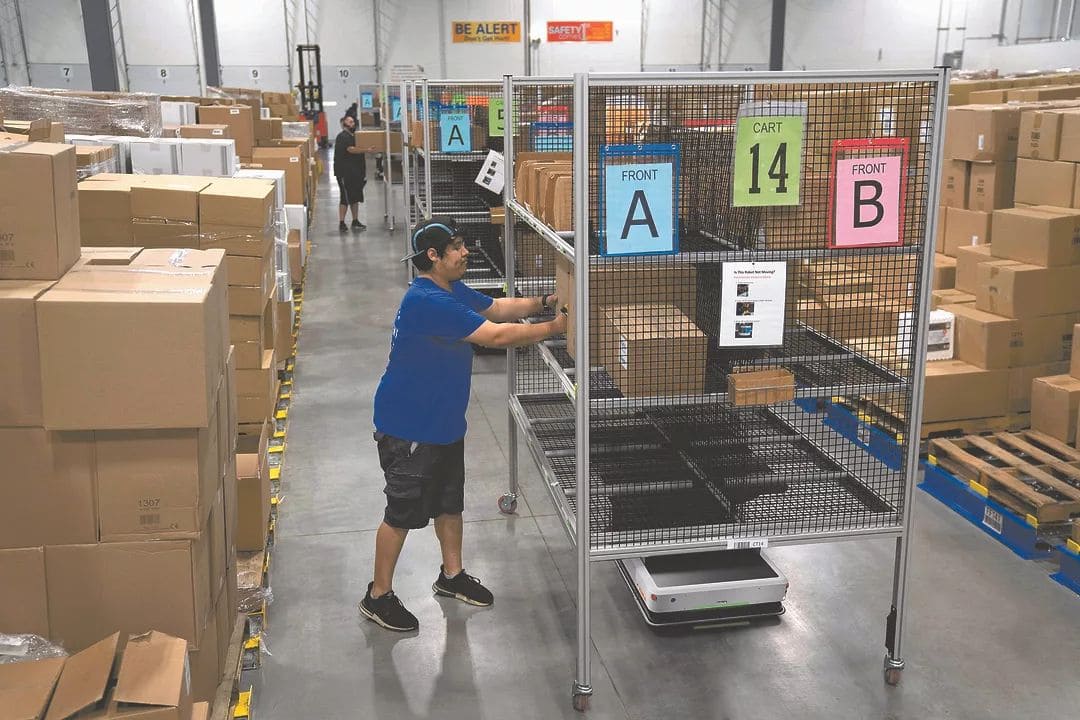
Autonomous mobile robots (AMRs) represent another area where AI delivers practical value in PHCP distribution centers by reducing walking, labor and reliance on fork trucks. Rather than following fixed routes, AI-enabled AMRs function as intelligent collaborators that continuously adapt to real-time warehouse conditions.
AI-enabled AMRs support operations through capabilities such as:
In practice, after each pick, the system evaluates time and travel distance to determine the next best pick for both the picker and the AMR. In practice a picker may continue picking in the same aisle with the same AMR, move one aisle over to meet a different AMR, while the original AMR travels several aisles away to meet another picker. This dynamic, pick-by-pick allocation continuously synchronizes picker and AMR movement to minimize travel and dwell time, while maximizing productive picking time.
When an AMR cart or pallet is pick-complete, it is automatically routed to packing, shipping or consolidation, allowing pickers to remain focused on picking while material flow continues uninterrupted.
This approach is effective for facilities with:
Integrating AMRs allows workers to spend significantly more time picking and less time traveling, with some operations exceeding 350 picks per hour, which rivals or exceeds the performance of many GTP automation systems, at a fraction of the cost and complexity.
Time, money and measurable ROI
PHCP distributors transitioning from manual or lightly automated operations can accelerate order fulfillment operations when they integrate an AI-enabled warehouse execution system (WES) with their WMS or ERP.
Real-world deployments show:
And those worries about needing an expensive, time-consuming equipment overhaul? Gone. AI is meant to amplify existing system investments, not replace them.
What about facilities that have already decided to deploy voice picking, conveyors or robotics? Well, when they introduce WES embedded with AI, they see continued improvements from intelligently coordinated technologies.
The biggest takeaway? Impressive gains don’t have to be from faster machines. They can be from smarter orchestration of people, processes and technology.
Artificial intelligence is not the future. It’s here and already delivering significant benefits in PHCP warehouse operations. By treating AI as a tool for continuous improvement and not a one-time upgrade, distributors can do more with the same labor while improving service levels and profitability for faster ROI.