
Why Numina Group’s RDS™ Batchbot™ Approach Uses Fewer Robots and Delivers More Throughput
When distributors start looking at AMRs, the most common question we hear is simple:
“How many AMRs do I need?”
It’s a fair question — but most AMR vendors provide the wrong answer.
In many cases, they recommend large fleets of small tote-carrying robots each handling tiny payloads. At first, that seems scalable. In practice, it often means more robots than necessary, higher congestion, and limited impact on actual picking productivity.
Numina Group takes a fundamentally different approach.
Instead of asking how many robots are required, we ask:
“How do we design the smartest, highest-throughput picking workflow—so you need fewer AMRs to get more done?”
The answer is RDS™ Batchbot™: a high-capacity AMR + Voice-directed picking workflow orchestrated entirely by RDS™ WES-WCS, built to maximize pick density, minimize travel, reduce forklifts, and multiply both each and case picking throughput.
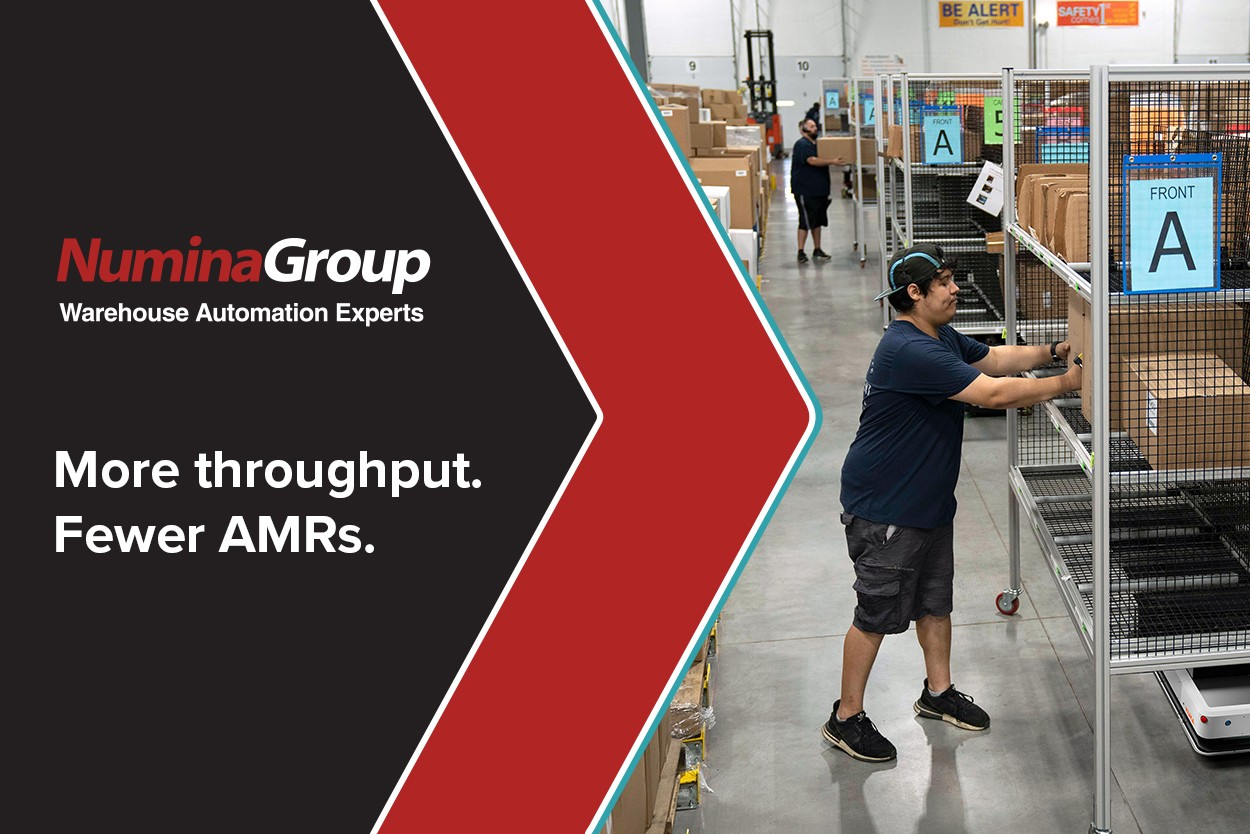
And because Batchbot™ uses high-capacity AMRs, not “little bots,” our customers achieve higher performance with significantly fewer robots.
The Numina Philosophy: AMRs Transport. People Pick. RDS Orchestrates.
Numina’s approach begins with a core principle:
AMRs are not the brain of the operation. RDS™ is.
RDS™ performs the real-time optimization that determines decisions like:
Meanwhile:
That combination — RDS + Voice + high-capacity AMRs — is the highest-productivity method for both each and case picking.
And it requires far fewer robots because each AMR moves hundreds of units or full pallets per mission, not a single tote.
Why Small AMRs Require Large Fleets
Most AMR systems on the market are built around low-weight tote carriers. To achieve meaningful throughput, they need:
Even then, throughput plateaus because
Batchbot™ solves all of these problems:
High-Capacity AMRs = Fewer Robots + More Throughput
Batchbot™ AMRs can transport:
This means:
When customers ask, “How many AMRs do I need?”
Our answer is often: Far fewer than you think.
Numina’s design centers on high-density batch cart picking, refined over 40+ years of RDS™ WES-WCS innovation.
Each Batchcart = 30–40 Orders
RDS™ Voice directs operators to pick multiple orders at every SKU location, driving:
RDS™ evaluates in real time:
The system continuously assembles the tightest, most productive batches, and Batchbot™ transports them — unlike tote-AMRs, which force batching tradeoffs due to limited capacity.
This is why Batchbot™ deployments achieve higher throughput with fewer robots.
RDS™ + Voice: The Real-Time Optimization Engine Behind Every Pick
Voice-directed operators become extensions of RDS™’s optimization logic.
RDS™ dictates:
Instead of AMRs “deciding what to do,” RDS™ delivers deterministic, rules-based orchestration to every resource in the building.
This is how Numina consistently delivers:
High-capacity AMRs deliver the most value when SKU storage supports efficient batch picks. RDS™ integrates slotting intelligence directly into order release logic, including:
Velocity-Based Slotting
Prioritize high-velocity SKUs in AMR zones.
Dimensional Velocity
Balance cube and movement to optimize pallet, case, and each-picking zones.
Affinity / Market Basket
Improve multi-order pick density by grouping frequently co-ordered SKUs.
Slotting is not an add-on—it’s part of RDS™’s ongoing optimization cycle.
Fewer mis-slotted SKUs = fewer AMRs needed to complete the same workload.
With Numina, usually 50–70% Fewer Than Small-Bot Systems
Because Batchbot™ carries more per trip and RDS™ drives higher pick density, you will typically require:
In case-pick-to-pallet operations, Batchbot™ often replaces:
Meanwhile, each-picking directly into the shipping carton—directed by RDS™ Voice—achieves far higher throughput than small AMR picking arms or tote-based GTP workflows.
FAQs: What Operations Leaders Ask About AMR Requirements
How scalable is Batchbot™?
Very. New AMRs or batch carts can be added in days without reprogramming.
Can the system adapt to new layouts or slotting changes?
Yes. RDS™ dynamically updates routes and workflows—no ML retraining required.
Why does Batchbot™ outperform smaller robots?
Higher payloads + higher batch density + RDS™ orchestration = fewer robots, more throughput.
What’s the typical ROI?
Most customers see ROI in under two years—driven by forklift elimination, labor savings, and higher throughput.
The Smarter Question Isn’t “How Many AMRs Do I Need?”
It’s “How do I get the highest throughput with the fewest robots?”
Numina Group’s answer is clear:
RDS™ real-time optimization
This approach scales effortlessly, adapts to changing profiles, and outperforms “little bot” systems in both each picking and case-pick-to-pallet workflows. Contact us to learn more
1. A Movers: The fastest-moving products (A+) are placed closest to the conveyor zone transfers and may be double-slotted to balance workload.
2. B-C Movers: Slower-moving items (C) are candidates for storing in shelving at the tail end of each pick zone.
3. Continuous Improvement: SKU slotting is an ongoing process. An advanced Voice Picking Suite can capture daily pick data to regularly re-evaluate slotting based on velocity changes especially during peak seasons.
4. Intelligent Slotting Recommendations: Software can suggest location adjustments when product movement no longer matches its assigned A, B, C slot, ensuring:
At The Numina Group, we partner with companies to design first, then identify and find the best blend of warehouse automation technologies that deliver measurable ROI. Our proven data-driven design approach creates a roadmap to streamline receiving, picking, packing, and shipping operations.
Our flagship Real-time Distribution Software (RDS™) is a modular and scalable Warehouse Execution and Control System (WES-WCS) platform that integrates with any WMS and ERP system. RDS provides a complete family of automation modules to optimize your operation, including:
1. Order Release Optimization and Cartonization: Dynamically determines the most efficient carton routing and balances picking across zones.
2. Voice Picking Suite: Industry-leading RDS voice-directed picking technology ensures accuracy and efficiency.
3. Batchbot AMR+ Voice: Automates each and mixed case pallet picking.
4. Goods to Person, GTP: Automated product storage and picking systems.
5. Conveyor and Sorting: Warehouse conveying automation solutions.
6. Pakt™ Automation: Automated pack-and-ship technology, including in-line weighing, vision inspection, sealing, and labeling.
With over 35 years in warehouse automation and software integration, Numina Group understands that every business is unique. We use a team of in-house automation experts to create, evaluate, and provide design and digital twin simulation services to pressure test the final warehouse automation design before implementation.
We work closely with your team to define lean and efficient processes and select the right technologies, whether Autonomous Mobile Robots (AMRs), Goods to Person (GTP), or voice-directed solutions, to deliver the highest end-to-end efficiency and throughput rates.
Ready to explore how Numina Group’s approach to warehouse automation can transform your business? Let’s start a conversation about your challenges and goals. Together, we’ll identify the automation investments that reduce labor costs, increase accuracy, and lower the total cost of fulfillment.
About Numina Group
Numina Group’s RDS™ is a modular and scalable software suite for warehouse automation software solutions optimized to streamline the entire pick, pack, and ship order fulfillment operation.