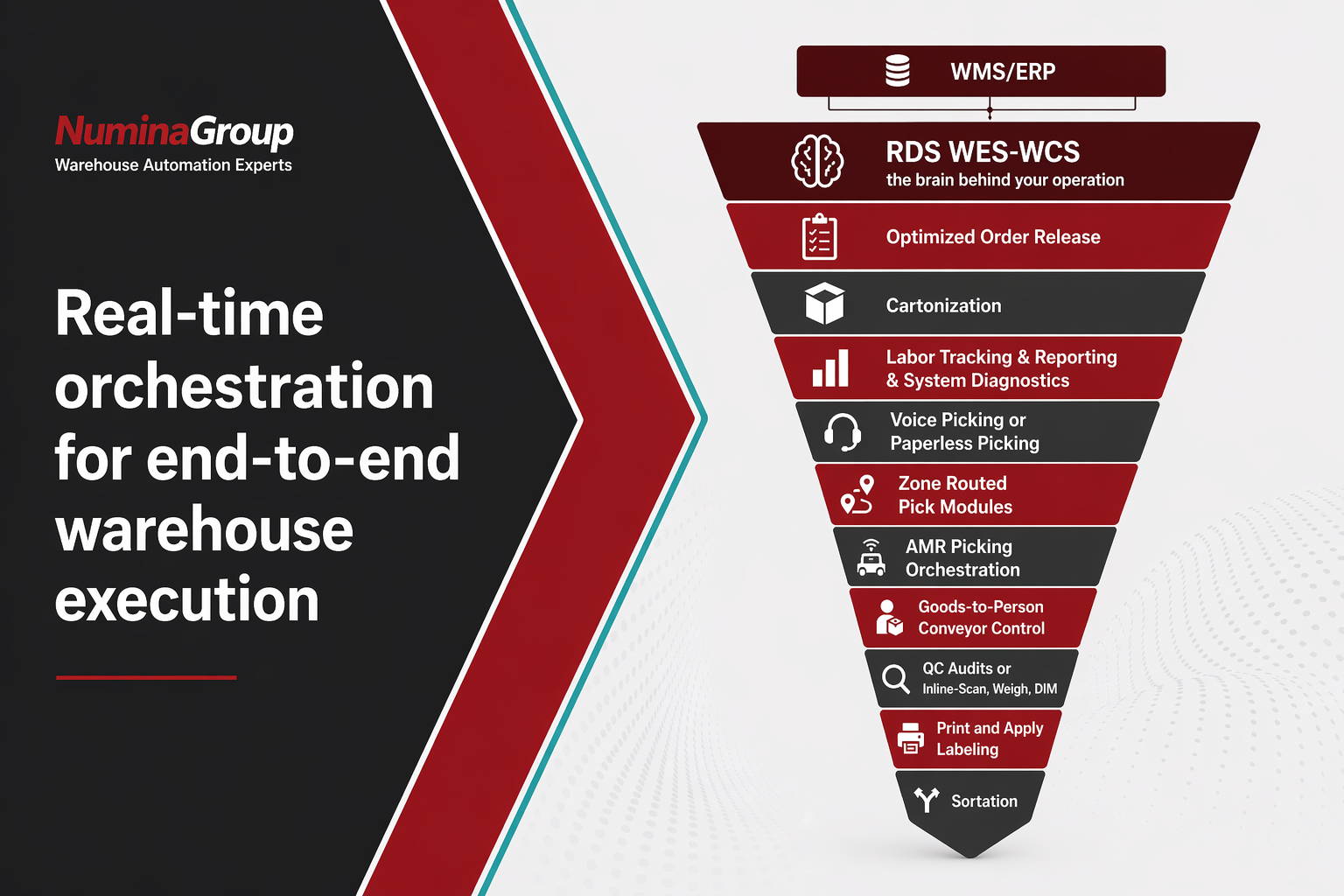



Modern warehouses face a familiar challenge: Orders are growing exponentially, but labor costs and error rates are climbing right alongside them. As distribution operations scale beyond basic inventory management, many operations teams discover their warehouse management system (WMS) or Enterprise Resource System (ERP) alone can’t orchestrate the complexity of real-time order fulfillment across multiple automation technologies. As a result, a warehouse execution system (WES) becomes essential.
A WES is a software platform that manages the real-time execution of warehouse tasks, optimizing order release and cartonization, directing labor and automation , and orchestrating order flow across your fulfillment operation. Unlike a WMS, which focuses on inventory tracking and location management, a WES acts as the intelligent control layer between your enterprise systems and the physical warehouse floor.
As an independent integrator with over 200 active sites deployed and supported, The Numina Group has seen firsthand how the right WES implementation transforms order fulfillment performance—reducing labor costs by 40–60% while dramatically improving accuracy and throughput. Our warehouse automation team created this guide to help you understand exactly what warehouse execution software does, whether your operation needs one, and how to evaluate vendors.
In this guide:
- What Is a Warehouse Execution System?
- WES vs. WMS/ERP vs. WCS: What’s the Difference?
- Key Features of a Modern Warehouse Execution System
- 5 Top Benefits of Implementing a WES
- How to Evaluate WES Vendors & System Integrators
- WES Implementation Timeline: What to Expect
- Tips for Integrating WES Systems
- Real-World WES Results: Numina Case Studies
- Warehouse Execution System FAQs
What Is a Warehouse Execution System?
A warehouse execution system is specialized software that manages and optimizes the moment-to-moment flow of work across a distribution center. Think of WES as the air traffic control system for your warehouse floor; it doesn’t track where inventory is stored (that’s your WMS) but rather determines which orders get released when, assigns the optimal picking method for each order line, routes work to the right automation or labor resources, and continuously adjusts execution based on real-time conditions.
Warehouse execution software performs four critical functions:
- Order release optimization: Rather than simply passing orders to the floor when they arrive, a WES analyzes order characteristics, current floor status, labor availability, and automation capacity to determine the optimal release timing and batching strategy.
- Task assignment and routing: The system dynamically assigns specific tasks to workers or automation based on location, equipment type, current workload, and efficiency calculations.
- Automation orchestration: For operations using conveyor systems, autonomous mobile robots (AMR), goods-to-person systems, or other material handling equipment, the WES coordinates all these technologies into a unified workflow.
- Real-time flow management: The WES continuously monitors execution metrics and adjusts work distribution to prevent bottlenecks, balance workloads, and maximize facility throughput.
The WES sits as a middle layer in your warehouse technology stack. Your enterprise resource planning (ERP) system and WMS tell it what needs to happen (which orders to fulfill, what inventory is available), while your warehouse control system (WCS) or individual automation equipment receives detailed execution commands. Some modern platforms—like our RDS system—uniquely combine WES and WCS capabilities in a single integrated solution, eliminating the complexity of managing separate point systems.
WES vs. WMS vs. WCS: What’s the Difference?
Understanding the distinction between a WES or ERP, WMS, and warehouse control system (WCS) is essential for making the right technology investment. While they work together, each serves a fundamentally different purpose in warehouse operations.
WMS/ERP | WES | WCS |
Inventory tracking and location management | Order release and task optimization | Equipment-level automation control |
Strategic: What to do (hours to days) | Tactical: When and how to do it (minutes to hours) | Operational: Physical execution (real-time, milliseconds) |
Warehouse managers, inventory planners | Operations supervisors, process engineers | Automation technicians, controls engineers |
Many operations need all three layers working together. However, the trend in modern distribution is toward unified platforms that combine WES and WCS functionality. Numina’s RDS platform exemplifies this evolution. It handles both execution logic and equipment control in a single system, reducing integration complexity and eliminating potential gaps between separate software layers.
When do you need WES alone versus WES plus WCS? If your operation relies primarily on manual processes with limited automation, a standalone WES integrated with your existing WMS may suffice. But once you introduce conveyor systems, sortation equipment, AMR fleets, or goods-to-person technologies, the combined WES-WCS approach becomes significantly more efficient and reliable.
Key Features of a Modern Warehouse Execution System
Leading warehouse execution systems share the following core capabilities that drive measurable performance improvements.
Order Release Optimization
Advanced WES platforms analyze incoming order streams and determine the optimal release strategy—whether wave-based batching, waveless flow, continuous, batch or hybrid approaches. The order release optimization system considers order characteristics, current floor congestion, labor shift schedules, and carrier pickup windows to maximize throughput while minimizing travel time and resource conflicts.
Real-Time Labor & Automation Orchestration
The WES continuously balances work across all available resources. If a goods-to-person station goes offline or an AMR needs charging, the system instantly redistributes tasks. This dynamic allocation ensures no resource sits idle while maintaining balanced workloads across pick, pack and ship.
AMR & Robotics Integration
For facilities deploying autonomous mobile robots, the WES manages the entire AMR workflow, from batch creation and mission assignment to coordinating robot traffic and optimizing charge cycles. Our Batchbot AMR, for instance, can transport up to 3,300 pounds and handle 38+ orders per mission, with the WES determining the most efficient batch composition for each trip.
Cartonization & Pack Optimization
Intelligent cartonization modules within the WES calculate the optimal packaging size and material for each order, reducing material costs and dimensional weight charges while maintaining product protection standards.
In each-picking operations, cartonization determines the correct shipping carton before picking begins, allowing operators to pick items directly into the right-size shipping carton, eliminating repacking steps and improving throughput.
For case picking and pallet operations, cartonization logic determines the pallet configuration, optimizing cube utilization, reducing partial pallets, and ensuring stable pallet builds for efficient transport and shipping.
Vision Audit & Quality Control
Integration with scan-weigh-dimension systems and vision technology enables automated quality verification. The WES can flag discrepancies, trigger exception handling workflows, and maintain complete audit trails for compliance and continuous improvement.
Labor Tracking & Analytics
Comprehensive performance monitoring tracks individual and team productivity metrics, identifies training opportunities, and provides data-driven insights for process optimization. This visibility helps operations teams make informed staffing and workflow decisions.
ERP, WMS, & Carrier Integration
Modern WES platforms seamlessly connect with enterprise systems like SAP or Oracle, warehouse management systems, and shipping carrier APIs. This integration capability ensures real-time data synchronization and enables end-to-end order visibility from receipt through final shipment. Built-in carrier connectivity also enables rate shopping and automatic selection of the best shipping service based on cost, delivery time, and service requirements, helping reduce transportation spend while maintaining delivery commitments.
5 Top Benefits of Implementing a WES
The value proposition of warehouse execution software extends well beyond simple automation. Operations that implement a comprehensive WES solution typically realize the following measurable improvements.
1. Labor Cost Reduction
Optimized task assignment and reduced travel time translate directly to labor savings. Numina’s client implementations consistently demonstrate 40–60% labor cost reduction compared to pre-WES operations. As a result, existing staff can fulfill significantly more orders per shift.
2. Order Accuracy Improvement
Directed workflows, real-time verification, and automated quality checks dramatically reduce picking errors. Many facilities that have implemented our WES achieve 99.9% accuracy or better, virtually eliminating costly returns and customer service issues related to fulfillment mistakes.
3. Walk-Time Reduction
Intelligent order batching and zone-based picking strategies can reduce travel time by 50% or more. In large distribution centers where pickers previously walked miles per shift, this reduction in walking time represents a massive productivity gain.
4. Pick Rate Improvement
When combined with automation technologies like AMR or goods-to-person systems, WES-orchestrated operations routinely see 50–100% pick rate improvements. Numina’s GTP Solutions and AMR Picking Automation , f, can achieve over 300 line picks per hour—far exceeding traditional cart-based picking rates.
5. Peak Season Scalability
Perhaps most valuable for growing businesses, a well-designed WES enables facilities to handle seasonal volume spikes without proportional increases in temporary labor. The system maximizes existing resource efficiency, which allows the same core team to process significantly higher order volumes during peak periods.
Is a WES Right for Your Operation?
Not every distribution center needs a warehouse execution system. But once operational complexity begins to outpace coordination, the limitations of a WMS alone become obvious.
The decision to implement WES is less about company size and more about execution complexity. As order volumes grow, fulfillment methods diversify, and automation technologies multiply, real-time orchestration becomes the difference between controlled growth and operational strain. The key question is whether your current systems can dynamically optimize labor, automation, and order flow in real time.
The following sections will help you determine whether your operation has reached that threshold.
Signs You’ve Outgrown Your WMS
Many operations recognize the need for WES only after inefficiencies start affecting cost, accuracy, and throughput. These challenges often surface gradually but become more pronounced as volume and complexity increase.
If your team is frequently intervening to rebalance work or resolve execution bottlenecks, that’s usually a signal your current system lacks real-time optimization capability.
Common indicators include the following:
- Excessive walk time and inefficient picking paths: Pickers revisit the same zones multiple times per shift because order release lacks intelligent batching and sequencing logic.
- Imbalanced workloads during peak periods: Certain pick zones or workstations become congested while others remain underutilized, requiring manual redistribution by supervisors.
- Manual coordination of automation systems: Conveyor systems, AMRs, or goods-to-person stations rely on human oversight to manage flow between technologies instead of operating under unified orchestration.
- Limited real-time visibility into floor performance: Supervisors depend on lagging reports rather than live dashboards to make operational decisions.
- Increasing order errors despite process training: As fulfillment complexity grows, manual controls struggle to maintain consistent accuracy.
When these symptoms appear consistently, they indicate that execution optimization is no longer happening at the system level. Instead, it is being handled reactively by people. That approach does not scale.
When Investing in a WES Makes Sense
Operational complexity alone does not justify new technology. Financial impact does.
A WES investment typically becomes viable when daily order volume exceeds 200 orders, multiple pick zones or fulfillment methods are in use, automation technologies have been introduced or are planned, labor represents a significant share of fulfillment cost, or order characteristics vary widely and require flexible execution strategies.
At this stage, the cost of inefficiency compounds quickly: travel time increases, labor allocation becomes inconsistent, and automation utilization falls short of its potential. Without a dynamic execution layer, growth often drives higher operating expenses rather than higher margins.
When these conditions are present, WES shifts from a performance enhancement tool to an operational safeguard that protects profitability as volume scales.
Understanding WES ROI
A warehouse execution system should be evaluated as a financial decision, not simply a technology upgrade. The strongest business cases focus on measurable operational improvements that directly impact cost structure, throughput capacity, and long-term scalability.
The primary ROI drivers typically include:
- Labor optimization: Intelligent batching and dynamic task assignment reduce wasted motion and idle time. Work is continuously aligned with real-time demand, increasing productivity without adding headcount.
- Error reduction: Directed workflows and automated validation reduce mispicks and reships. Improved accuracy protects the margin and strengthens customer satisfaction.
- Throughput expansion without facility growth: Optimized order release and automation coordination allow higher volumes to be processed within the same footprint, supporting revenue growth without immediate expansion.
- Peak season scalability: WES helps absorb seasonal spikes by maximizing existing labor and automation resources, reducing reliance on temporary staffing.
- Automation orchestration: WES synchronizes robots, vechicles, conveyors, sorters, and workstations so people and automation operate as a single coordinated system, eliminating bottlenecks and maximizing equipment utilization.
- Real-time operational visibility: Live dashboards and performance analytics provide immediate insight into order status, labor productivity, and system throughput, enabling faster operational decisions.
- Faster order cycle times: Intelligent order release and dynamic workflow management reduce queue times between picking, packing, and shipping processes, accelerating order fulfillment.
Most mid-market operations that meet the complexity profile outlined above see payback within 12–24 months. After that recovery period, ongoing labor savings and throughput gains continue to compound year over year, strengthening long-term operational resilience and profitability.
How to Evaluate WES Vendors & System Integrators
Choosing the right warehouse execution system partner is as important as selecting the technology itself. The vendor landscape includes equipment manufacturers offering bundled WES solutions, pure software providers, and independent systems integrators. Each brings different advantages and potential limitations.
Independent integrators like The Numina Group offer a critical advantage: technology agnostic implementation. Rather than being tied to a specific equipment manufacturer’s ecosystem, an independent integrator evaluates your requirements and recommends the best combination of technologies, whether that’s a conveyor from one vendor, AMR from another, and print and apply labeling from a third. This approach consistently delivers better long-term value because the solution is optimized for your operation, not the vendor’s product catalog.
Ask these questions before selecting any WES vendor:
- Are you equipment-agnostic, or do you primarily implement your own proprietary automation?
- How many active sites do you currently support, and what is your average client relationship duration?
- What performance guarantees do you provide in writing, and what happens if targets aren’t met?
- Do you offer 24/7 support after go-live, and what is your average response time for critical issues?
- Can your WES integrate with our specific ERP platform and existing automation equipment?
- What is your implementation methodology, and how do you handle change management?
- Do you provide ongoing optimization services, or is support limited to break-fix maintenance?
- Can you share references from clients with similar operational profiles and volume characteristics?
The term “guaranteed performance” deserves special attention. Most vendors provide general estimates or best-case scenarios. Numina backs implementations with written performance guarantees—specific, measurable commitments regarding throughput, accuracy, and system uptime. Our level of accountability is rare in the industry and represents a significant differentiator when evaluating partners.
WES Implementation Timeline: What to Expect
Reviewing the implementation process helps set realistic expectations and ensure proper resource allocation. While specific timelines vary based on operation complexity, most WES deployments follow this general framework.
Phase 1: Design Study & Site Evaluation (4–8 Weeks)
The integrator conducts a detailed analysis of current operations, SKU analysis, data flows, and facility constraints. This phase produces a comprehensive system design including technology recommendations, layout optimization, and projected performance metrics.
Phase 2: Technology Selection & Layout Planning (4–6 Weeks)
Specific equipment and software components are selected, and procurement begins. Detailed facility layouts are finalized, including workflow diagrams, network infrastructure requirements, and construction coordination.
Phase 3: Integration & Deployment (8–16 Weeks)
Physical installation occurs alongside software configuration and testing. This phase includes ERP or WMS integration, automation equipment commissioning, and comprehensive system testing with production data.
Phase 4: Go-Live & Hypercare Support
The system goes into production with intensive on-site support. The hypercare period typically lasts 2–4 weeks, with the integration team available to quickly address any issues and optimize performance based on real-world conditions.
Phase 5: Optimization
Numina’s proven five-phase process includes an additional optimization phase that continues 30–90 days post-launch. During this period, our WES team analyzes performance data, fine-tunes workflows, and ensures the operation is achieving guaranteed performance targets before transitioning to standard support.
Tips for Integrating WES & ERP Systems
Integrating a warehouse execution system with your ERP is a strategic alignment of business logic with operational execution. Your ERP defines what needs to happen, such as order details, inventory availability, and financial data. The WES determines how and when those actions occur on the warehouse floor.
When integration is poorly planned, data delays, mismatched logic, and manual workarounds undermine performance gains. A thoughtful integration strategy ensures both systems work as a coordinated ecosystem rather than competing layers of control.
Define Clear System Roles
Before integration begins, establish which system owns which decisions.
The ERP should remain the system of record for order creation, customer data, and financial transactions. The WES should control execution logic, including order release timing, task prioritization, and automation coordination. Blurring these responsibilities leads to duplicate logic, conflicting updates, and unstable workflows, while clearly defining system boundaries prevents unnecessary customization and simplifies long-term maintenance.
Standardize Data Structures Early
Data inconsistencies are one of the most common integration challenges. Standardize stock keeping unit (SKU) formats, unit of measure conventions, location codes, and order status definitions before connecting systems. Aligning master data structures upfront reduces rework and prevents errors once transactions begin flowing between platforms.
Clean data architecture accelerates testing and minimizes disruption during go-live.
Prioritize Real-Time Communication
Execution systems depend on timely information. Delayed order updates or inventory confirmations reduce the effectiveness of dynamic optimization.
Design integrations to support near real-time data exchange whenever possible. Whether using APIs, middleware, or event-driven messaging, prioritize speed and reliability over batch-based synchronization. Real-time visibility enables the WES to make informed decisions that improve flow and responsiveness.
Test with Real Order Profiles
Comprehensive testing reduces risk and builds confidence across operations and IT teams. System testing should reflect actual operational complexity, not simplified scenarios. Use real order data that represents peak periods, diverse SKU mixes, and varied fulfillment methods. This approach validates that integration logic performs under realistic conditions and exposes bottlenecks before go-live.
Plan for Exception Handling
ERP and WES integration isn’t complete without a strategy for managing errors and edge cases. Clear exception protocols prevent minor integration issues from cascading into operational downtime.
Define how each system handles order changes, inventory discrepancies, or communication interruptions. Determine whether the ERP or WES resolves specific exceptions and establish escalation workflows.
Establish Post-Launch Monitoring
Integration success doesn’t end at go-live. Monitor data flow accuracy, latency, and system synchronization during the first 30–90 days of operation. Regular review of integration performance helps identify optimization opportunities and prevents small data misalignments from becoming long-term inefficiencies. This ongoing oversight ensures both systems continue operating as a unified fulfillment engine.
Real-World WES Results: Numina Case Studies
Theory matters, but results prove capability. These real client implementations demonstrate the tangible impact of properly executed WES deployments. They share common themes: significant labor optimization, maintained or improved accuracy despite higher volumes, and the ability to scale operations without proportional resource increases.
The specific results vary based on starting conditions and operational requirements, but the pattern of substantial ROI remains consistent across diverse industries and facility types.
Visual Comfort: Scalable Omnichannel Fulfillment
Visual Comfort & Co. implemented Numina Group’s RDS™ WES to power a new 800,000-square-foot automated distribution center supporting its rapidly expanding omnichannel business. Intelligent order release, voice-directed picking, and coordinated automation workflows allow operators to pick up to 350 units per hour while managing significantly more order lines per trip. The system enables high-throughput fulfillment while maintaining the accuracy and reliability required to support both wholesale and direct-to-consumer channels.
Rainbow Resource Center: Direct-to-Consumer Fulfillment
Rainbow Resource Center implemented Numina Group’s RDS™ Warehouse Execution System to orchestrate high-volume direct-to-consumer order fulfillment across its catalog and e-commerce operation. Intelligent order release, directed workflows, and real-time coordination of automation and labor enable the facility to efficiently process thousands of multi-line customer orders. By synchronizing picking, packing, and shipping processes, the system increases throughput and accuracy while ensuring fast, reliable delivery directly to customers nationwide.
Northshore Care Supply: Scaling With Batchbot AMRs
As their business expanded rapidly, Northshore needed to modernize operations while maintaining service levels. The integrated WES and WCS platform with RDS Batchbot AMRs and Voice picking provided the real-time visibility and automation control necessary to scale efficiently, supporting business growth without the operational chaos that often accompanies rapid expansion.
Warehouse Execution System FAQs
What Does a Warehouse Execution System Do?
A warehouse execution system manages the real-time flow of work inside a distribution center. It optimizes order release, assigns tasks to labor and automation, balances workloads across zones, and continuously adjusts execution to maximize throughput and accuracy.
How Is a WES Different from a WMS?
A WMS focuses on inventory management, order management, and location control. A WES focuses on how and when work is executed on the warehouse floor. While a WMS tells the warehouse what needs to be done, a WES determines the most efficient way to complete those tasks in real time.
Do I Need a WES if I Already Have a WMS?
If your operation includes multiple pick zones, automation technologies, or complex order profiles, a WMS alone may not provide the execution optimization required. A WES becomes valuable when real-time coordination and workload balancing are critical to maintaining efficiency and accuracy.
Can a WES Integrate with My Existing ERP System?
Yes. Modern warehouse execution systems integrate with leading ERP platforms to receive order data, inventory status, and shipping information. Proper integration allows seamless communication between business systems and warehouse operations, creating end-to-end visibility.
Does a WES Replace a Warehouse Control System (WCS)?
No. A WES orchestrates workflow and decision logic, while a WCS controls individual pieces of equipment at the machine level. Some platforms combine WES and WCS functionality into a unified solution, reducing integration complexity and improving system coordination.
How Long Does It Take to Implement a Warehouse Execution System?
Implementation timelines vary based on operational complexity, facility size, and automation scope. Most WES deployments take several months from design through go-live, followed by a short optimization period to fine-tune performance.
What Types of Automation Work Best with a WES?
A WES can coordinate conveyors, sortation systems, autonomous mobile robots, autonomous fork trucks, autonomous pallet jacks, goods-to-person systems, pick-to-light technologies, scan-weigh-dimension systems, print and apply labeling, and high speed soration. It serves as the orchestration layer that connects and optimizes these technologies.
How Quickly Can a WES Deliver ROI?
For operations with sufficient volume and complexity, payback typically occurs within 12–24 months. Labor savings, improved accuracy, and increased throughput are the primary drivers of financial return.
Is a WES Only for Large Distribution Centers?
No. While high-volume facilities often benefit the most, mid-market operations can also see significant value once order complexity, labor costs, or automation usage reach a certain threshold
Contact Numina to Find the Best WES for Your Operation
A warehouse execution system is the intelligent orchestration engine that transforms separate systems and processes into a coordinated, optimized fulfillment operation. For distribution centers dealing with growing order complexity, multiple automation technologies, or scaling challenges, a WES provides the real-time execution intelligence that a traditional WMS alone cannot deliver.
The right warehouse execution system, implemented by an experienced independent integrator, fundamentally transforms your competitive position by enabling you to fulfill more orders, more accurately, with less labor cost than you previously thought possible.
The decision to implement WES software should be driven by clear operational requirements and ROI potential, not technology trends. If your operation processes 200+ orders daily across multiple zones, relies on any form of automation, or struggles with labor efficiency and accuracy issues, you’ve likely reached the point where a WES investment makes financial sense.
Ready to see what warehouse execution software looks like for your specific operation? Start with our free automation project checklist—a practical tool that helps you assess your current state, identify optimization opportunities, and determine whether your facility is ready for WES implementation. For operations already evaluating WES vendors, schedule a consultation to discuss your requirements and see our RDS WES platform in action through a customized demo based on your actual order profiles and facility constraints.